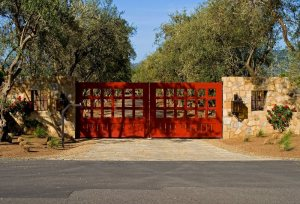
While working and living in Sonora, Texas, many years ago, I had to become very familiar with gates. Not just any kind of gate, but bump gates. A bump gate allows you to pull up to the gate, bump it with your vehicle and proceed through while it swings open. You better not dilly-dally, either. If you do, the gate will swing shut and leave a nasty dent in the side of said vehicle. (are so I’ve been told) I can tell you that I became quite adept at getting through those gates until the day I tried to squeeze a 30′ gooseneck trailer through before the gate swung close. Neither the gate nor the trailer faired very well.
I was not doing anything illegal I was simply fulfilling my responsibilities while working in the oil patch. (In Sonora, it was mostly gas wells I worked) Those bump gates, or swing gates as they are also known, were put in place many times by the Oil company that had lease rights to a section of land. On a couple of occasions, I pulled up to a bump gate to notice that an extra layer of security was added. On one such occasion, it was in the form of a padlock. The other was a delightful rancher with a sawed-off 12 gauge shotgun awaiting me to discuss the previous event of gate and gooseneck trailer.
So what is the point of this little journey down memory lane? Simply that gates have a purpose. Mostly, they are meant to keep you out of what is on the other side. In the Bible, the “gate” is used 279 times in over 200 verses of scripture. There is a view of Moses standing at the gate asking if you are on God’s side to come through this gate (image of the Golden Calf Exo.32:26). There was the time that King David went to the chamber above the gate and cried over the death of his son Absalom (2Sam.18:33). Or there is this from our Lord and Savior in Mat.7:13,14:
Enter ye in by the narrow gate: for wide is the gate, and broad is the way, that leadeth to destruction, and many are they that enter in thereby. For narrow is the gate, and straitened the way, that leadeth unto life, and few are they that find it.
However, what I want to write about today are gates we find in the book of Nehemiah chapter 3. There are 10 gates listed, each carrying its own significance. The gates are in order of occurrence: Sheep, Fish, Old, Valley, Dung, Fountain, Water, Horse, East, and Muster (Inspection). What I want to do is briefly describe the use of the gate and then, hopefully, make an application for us today. These are my thoughts; if you have a different thought, feel free to share it with me.
- Sheep Gate – This is where you could come to purchase sheep. One scholar has said that it may have been the gate where sheep were led on their way to be sacrificed after washing in the pool of Bethesda. Not sheep for the slaughterhouse, but those to be sacrificed, a male without blemish. (see Lev.1:10-13 “Burnt Offering”) Remind you of anyone? Jesus was that once and for all “lamb” without blemish (sin) sacrificed for the sins of all. The application in my mind’s eye is this is where we begin our close walk with the Lord through the “Sheep Gate.” I am reminded of the parable of the lost sheep, specifically the account from Luke chapter 15. It is the vivid picture of our Lord and Savior leaving 99 to find 1. Such a beautiful picture and deserving of a thorough study.
- Fish Gate – This gate is probably where the fish market was located. (see 2Chron.33:14; Zeph.1:10) The road would lead north, then west to the Mediterranean to the port of Joppa, so the gate was aptly named. So what is the application for us today? When we begin our walk with Christ (Sheep Gate), we become his army. An army of Christians commanded by our Lord to “Go!” (Mat.28:18-20 The Great Commission) We are to become “Fishers of Men.” Simply, we are to spread the good news of Jesus Christ; his life, his death, his resurrection, and what it means to walk in his way.
- Old Gate – There is a lot of text on this gate as well as scholarly debate. The Hebrew word used here represents that which sleeping – figuratively to die. There are other transliterations for this gate; I will stick to the Hebrew meaning. The application, I believe, comes from Colossians 3 verses 1-17. We are to put off the “old man” and put on the “new.” This gate in Nehemiah was repaired and made to be New. In the same way, we remove all of the filth that makes up the old and cover ourselves in the beauty of the new – Jesus!
- Valley Gate – Not much is known about this gate; you do see Nehemiah inspecting the wall and the gates thereof in chapter 2, beginning verse 12 and following. I can think of no better application of a “valley gate” than of our daily walk with God. There are times when we are in the lowest depths of our life. Literally, we feel completely estranged from God. Our desire is not for Him; we go back to the old man of life. Folks, the reality is we will have valleys in our worthy walk with the Lord. I certainly have had my share. It’s when we call upon the Lord, through the avenue of prayer, that we begin to rebuild that valley gate. Remember, the gates were not repaired by one individual; it took many. So, heed the words of Paul from Galatians Chapter 6, verses 1-10. The key is to “bear” one another’s burdens. (I.e. vs. 2)
- Dung (refuse) Gate – Isn’t it interesting that the dung gate was located in proximity to the valley gate. This gate literally was the passageway to remove all waste from inside the wall and to be burned. To me, the application is simple; it’s the place where we can get rid of all the rubbish in our life. I go to this gate often in prayer, asking God to help me be the kind of man that is worthy to be called one of His. It’s when I’m in the valley that I see the need to remove the trash. Figuratively burning it, never to wear it again. I must remind myself daily to “Put on then, as God’s chosen ones, holy and beloved, compassionate hearts, kindness, humility, meekness, and patience, bearing with one another and, if one has a complaint against another, forgiving each other; as the Lord has forgiven you, so you also must forgive. And above all, these put on love, which binds everything together in perfect harmony. And let the peace of Christ rule in your hearts, to which indeed you were called in one body. And be thankful.” (Col.3:12-15)
- Fountain Gate – This gate was important to the Jews because it was a reminder of their glorious past. It was close to the “King’s garden.” “The pool of Siloam” was beneath the gate which Hezekiah built, the best King in the Southern Kingdom. (2Ki.20:20; 2Chron.32:30) The application for me is that when I “put on” Christ through baptism, I receive the indwelling of the Holy Spirit that helps me through my daily life to live according to the word. When I hurt, when I’m in the valley or on the dung heap, the fountain, the helper, the Holy Spirit covers me. He takes me before the throne of God and pours the words of my heart out before the Father so I can be strengthened, lifted from the valley of life to the healing power of the cross.
- Water Gate – This gate is mentioned next and has a connection to Ezra’s reading of the Law to the people. (Neh.8:1) There, all the people gathered as one to hear the reading. It appears that this is the only gate that did not require repairs; at least, nothing was mentioned about repairs. The application for me is to spend more time in the word of God. We need God’s word when we walk in the light. The word (Bible) illuminates the way for us to travel in our journey as a child of God. It will provide us answers to our most difficult problems. It is not a “gospel of prosperity” that if you trust in the Lord, you will gain wealth beyond imagination. It is a Gospel of Everlasting Life. That is, you will gain eternity with our Lord when you abide in His word. The Bible is truth; it does not change – however, it will change your life.
- Horse Gate – This is where the king’s horses entered the city to be watered at the brook Kidron. When I think of horses, I see the image we are given of the “white horse” in Rev.19:11. The horse’s rider was “Faithful and True,” the one in righteousness who will judge and wage war against the great beast. The application is today; we have that same rider, faithful and truly ready to defend his bride against Satan and his armies. It gives us comfort to know that we do not fight alone. That our battles with sin are defeated when we place ourselves at the feet of our savior, fully, wholly submitting our lives to him.
- East Gate – The important thing to note here is the keeper of the gate, Shemaiah, also repaired the gate. The gatekeepers were guards who granted or refused entrance through the gate. It was security for the people. My application is Jesus as the gatekeeper, protecting me, securing me from the evil one. He “repairs” me daily when I humbly seek his will. I can be as confident as David in Psalm the 23rd chapter:
“The LORD is my shepherd; I shall not want. He makes me lie down in green pastures. He leads me beside still waters. He restores my soul. He leads me in paths of righteousness for his name’s sake. Even though I walk through the valley of the shadow of death, I will fear no evil, for you are with me; your rod and your staff, they comfort me. You prepare a table before me in the presence of my enemies; you anoint my head with oil; my cup overflows. Surely goodness and mercy shall follow me all the days of my life, and I shall dwell in the house of the LORD forever.”
- Inspection Gate – It appears this is akin to Neh.12:39, Named the “Gate of the Guard.” The beauty of this gate is where all came together, the priests, the singers, the women, and the children at the dedication of the wall. They rejoiced greatly to God of creation. There will be a day when we will all give an account of our life lived on earth. Did we align ourselves with Jesus Christ, or did we choose to walk the path of destruction? We are reminded of this from Revelation 21:27
“But nothing unclean will ever enter it, nor anyone who does what is detestable or false, but only those who are written in the Lamb’s book of life.”
I leave you with this question: when we are inspected, what will our hearts reveal?
I would encourage you to read and study the books of Ezra and Nehemiah. Ezra provides us God’s sovereignty, while Nehemiah paints a beautiful picture of sacrificial godly leadership. Nehemiah was opposed and ridiculed, but he kept on keeping on; he finished the task. As Paul would write: “I have fought the good fight, I have finished the race, I have kept the faith.” (2Tim.4:7)

