Thursday, the eve of His crucifixion – Jesus is in the garden!
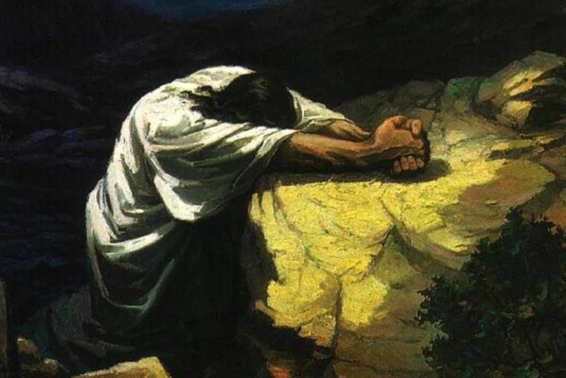
He went a little farther and fell on His face, and prayed, saying, “O My Father, if it is possible, let this cup pass from Me; nevertheless, not as I will, but as You will.” (Mat 26:39 NKJV)
On this fateful Thursday evening, Jesus descended from Jerusalem to a private garden, an orchard of olives trees at the foot of the Mount of Olives, to prepare Himself to be the atoning sacrifice for the world’s sin. In the middle of the night, this prayer vigil threw Him into the most significant struggle He had ever faced. At the beginning of His ministry, He had met the devil for a period of temptation. That supernatural conflict was fierce, energy-sapping, and historical, but throughout its forty days of trial, Jesus was confident, in control, and victorious. However, the battle that raged in this garden was far more intense.
Matthew, Mark, and Luke used six of the most assertive phrases in the Greek language to depict the sufferings that Jesus underwent. He told His disciples that He was “deeply grieved,” and He also said that His grief had brought Him down “to the point of death” (Matthew 26:38). Mark reported that he began to be “very distressed” and “very . . . troubled” (Mark 14:33). Luke said, “And being in agony he was praying very fervently”; “His sweat” became “like drops of blood” and was “falling down upon the ground” (Luke 22:44).
Leaving eight of His apostles at the gate of the garden, Jesus took Peter, James, and John—three apostles, with whom He had a particular affinity—and walked among the olive trees. The garden must have been dark and lonely. After telling His three followers that He was exceedingly sorrowful and needed them to be watchful and pray, He left them. Going beyond them a short distance that one could toss a stone (Luke 22:41), He began to pray. Matthew described the scene by saying that “He went a little beyond” the place where He left the three disciples (Matthew 26:39). Luke’s account says that He “knelt down” under one of the trees (Luke 22:41). Mark added that He soon bowed down “to the ground” (Mark 14:35), and Matthew put the final touch on the scene by saying that He “fell on His face” before God (Matthew 26:39).
The accounts by these three synoptic writers imply a gradual increase in the intensity of our Savior’s praying. At first, He knelt down and prayed. As the burden upon His heart grew heavier, He bowed down to the ground. Finally, being overwhelmed with the weight of His sorrow, He fell on His face before His Father. Can anyone imagine the Son of God being so heavily laden with sorrow that He would be driven by its weight to fall on His face before God?
Doctor Luke further provides an important detail of our Saviors ordeal: “And there appeared to him an angel from heaven, strengthening him.” (Lk.22:43 ESV) You see, in his agony, in his struggle, God had not forgotten his son. Not at this moment did God turn his face away from our Savior; He sent an angel from heaven to give him strength. A vivid reminder to me is one of my earthly father. I’ll spare you the details, but in one of the greatest times of need, there is my dad, an arm placed on my shoulder letting me know that he is always with me. In pain and agony, in victory, providing that much-needed reinforcement that only dads can provide.
God provides that for us today with His spirit in us, giving us strength in a time of need. It was the strength I received when I lost my father 28 years ago this coming May. Of course, to receive this comfort, you, like Christ, must conform to the will of God. Can we utter the words, “Your will be done?”
Matthew, Mark, and Luke gave a summation of what our Savior said to His Father under the branches of those olive trees during what must have been the world’s darkest night. He engaged in three periods of prayer, punctuated by two returns to the three apostles to receive their comfort and to give them a gentle reminder to pray with Him and for Him. As we meditate upon these three prayers, we enter into the holy heart of our wonderful Savior. Let us not only witness but also partake, to a small degree, in His sufferings for our sins.
First, we see Jesus praying.
Jesus praying depicts His humanity, His oneness with the human race. Only humankind prays. The stars, moon, sun, animals of the fields and forests, birds of the air, and fish of the sea cannot pray. They do the will of God without thought and choice. Humanity thinks, reasons, believes, and intentionally looks up to God with their prayers of thanksgiving, petitions, and supplications. When we come to life’s dark valleys, the crushing, overwhelming struggles, we alone can fall upon our face before God.
I am reminded of David’s plea to God after Nathan brought to the forefront David’s sin. I can see David in great despair and sorrow in words he utters: “Have mercy on me, O God, according to your steadfast love; according to your abundant mercy blot out my transgressions…” (Ps.51.1b)
David knew his sin; he felt the utter loss of relationship with God as he fully understood that only those who would be righteous could abide in the presence of God. Only humankind can feel this; no other creature can experience this or have this relationship with God. When we submit to the whole will of God, we have this blessing of coming before the Creator with our struggles, our trials, and in full assurance that He hears.
Jesus is the second member of the Godhead, yet He prayed to His Father as His Servant, who desperately needed His strength. He approached His Father for communion, sustenance, and a new understanding of what He must do. According to Mark, under this darkened sky, He cried out, “Abba! Father!” (Mark 14:36). “Abba” is an Aramaic word that suggests closeness and intimacy with God. Jesus laid His great burden before His God in prayer. Jesus, as the perfect Man, prayed.
Second, we see human reasonableness in His prayers.
Jesus focused upon the awful cost of redemption, which was only one day away. He asked His Father, “Do You know of any other way?” He was fully and wholly man, yet fully and completely God the Son. As He saw the cloud of suffering billowing up—as He saw the approach of the awful hour for Him to bear the guilt of the sin of the world—His human side asked, “Is there any other way to do this?” He had already seen the crucifixion coming toward Him, and He had accepted it. Much earlier in His ministry, He had said to His disciples, “Now My soul has become troubled; and what shall I say, ‘Father, save Me from this hour? But for this purpose I came to this hour. Father, glorify Your name” (John 12:27, 28a). With His question, Jesus was not shrinking back from the cross. He had not changed His mind about it. He, the Son of Man, was facing all of its horrid dimensions with human reasonableness. We need to understand the lesson in doing God’s will that, at times, His will could be unpleasant. Indeed, living in the United States, we have not faced death as a possibility of submission to God’s will. Still, that day could come if we continue to remove God from our (America) homes, continue to ignore history, and realize that all great nations were humbled before the Creator for their arrogance. What will you do if one day you are faced with the decision to stand on the side of God and His eternal will or to side with the populace?
Remember these words from Jesus when he concludes the sermon on the mount: “Not everyone who says to me, ‘Lord, Lord,’ will enter the kingdom of heaven, but the one who does the will of my father who is in heaven.” (Mt.7:21) Name dropping won’t work; only in “will doing” can your hope be confirmed. (See Rom.8:28b)
Third, His prayers show us that He was seeking God, regardless of the cost.
He had never intended to avoid God’s eternal purpose. In the first period of His prayers, He implied that He did not come into the garden to pursue His wishes but to offer Himself for the fulfillment of God’s will.
How long the Lord Jesus remained prostrated on the ground absorbed in this anguish of soul, we do not know. He referred to it as “one hour” (Matthew 26:40), but He must have used the word figuratively. However, he uttered this petition (Matthew 26:39) at the very beginning of His time of supplication in the garden. Later, during His second prayer, He said, “My Father, if this cannot pass away unless I drink it, Your will be done” (Matthew 26:42). Doing God’s will was foremost in His mind from start to finish. If the will of God had nothing in it but a cross covered with agony and blood, Jesus was ready to accept that.
From the beginning of His praying to the end of the hour, He exhibited an underlying, unshakable resignation to God’s eternal purpose. Jesus did use the “if” of possibility at the opening of His prayers: He said, “My Father if it is possible, let this cup pass from Me.” Alongside “if,” he used the “yet” of reality: He said, “Yet not as I will, but as You will.” We sometimes use “if” in an attempt to bargain with God. We say, “If You provide another way, then I will accept it; if You do not, I am through.” Jesus did not use “if” in this way. We use it to demand our way; Jesus used it as He sought God’s will. Jesus said “yet” to declare that—whatever might come, sweet peace or a bitter sword—He would do what God wanted Him to do.
The lesson we learn from our Savior in the garden is that the will of God must be our priority. By example, He leads every disciple to say, “My Father, not my will, but Yours be done.” God’s will towers above everything else; there can be no rival. Regardless of the circumstances or the consequences—regardless of what I must do, how I must do it, or how long I will have to do it—His will must be my first ambition. Though the night may be dark, though the pain may be unimaginable, though the humiliation may be unbelievable, doing the will of God is the only way to peace and eternal life!
 Heart and Mind